

Nobody watches a dog come apart at the front door for ten years and then tells you a chew is the whole answer. I'm Deb, and I train dogs in ordinary homes around Springfield, Missouri. The dog in my own living room is June, a shepherd and Lab mix who used to start whining the second she saw me pick up my keys. I have sat on too many floors with clients talking through the same moment: the goodbye, the closed door, the bark that does not stop. If that picture is familiar, I want to be straight with you before we get anywhere near a jar. A calming chew is a tool, not a cure. But for a dog who is not truly in panic, just stuck in a loop of wakeful worry, it can be the difference between a door you dread and a dog who settles.
NaturVet Quiet Moments is the soft chew I hand to owners who say they need something to take the edge off before they leave. It is marketed as calming support, not as a medication, and that difference matters. If a dog spends the whole workday crying, scratches at the door until his feet are sore, or digs at the crate until he is bloody, do not order anything from the internet. That dog needs a veterinarian and a behavior plan, not a supplement. What a supplement can do is help a dog who is mildly restless, who whines for a bit and then settles, but who could use help getting over the first hump. This article is about that second dog.
If you are reading this, you have probably tried the obvious things already: a longer walk, the radio on, a big production at the door. I have sat with owners who tried a different calming treat, a thunder shirt, or just hoped the dog would grow out of it. None of that makes you a bad owner. Dogs do not come with a manual, and every quiet ritual you build is practice for the next one. What I want to give you is a sequence, not a single fix. The steps below are the order I use in living rooms when a dog cannot settle after the owner leaves. The chew is step five, not step one, and that is the most honest thing I can say.
The first ten minutes decide the whole day
A quiet first ten minutes after the door closes is the foundation. NaturVet Quiet Moments can smooth that rough patch, but only when the training around it is solid. Read the five steps, then decide for yourself.
Amazon Check today's price on Amazon →Step 1: Talk to your vet before you order anything
Call your veterinarian before you buy a thing. I put this first because most owners skip it, and skipping it is where supplements go wrong. Ask whether a hemp based calming product is safe for your dog's current health. Ask about age, weight, and other medications. It matters whether the thyroid is normal, whether the liver is handling the dog's food and flea medication well, and whether there is an unnoticed ear infection that makes a dog pace and pant. I saw a senior dog whose owner thought she had separation anxiety. The real problem was a urinary tract infection. The dog did not need a chew; she needed antibiotics. That one phone call would have saved her owner a lot of money and a lot of false hope.
When your vet says it is okay to try a supplement, read the jar label out loud to yourself. NaturVet Quiet Moments lists hemp and a blend of botanicals, and it is meant to be given with food, not on an empty stomach. Keep the jar in the kitchen cabinet, not beside the door. That way the supplement is part of the routine, and not part of the goodbye. Write the amount your vet approved on a piece of masking tape and stick it to the jar. I do this for every supplement I use with June, because I do not trust myself to remember numbers when I am rushing out the door.
Ask your vet how soon before departure to give it. Most calming supplements need at least thirty minutes, and some work better after a full hour. The timing has to be part of the plan before you start Step Four, because a chew given as the front door opens is no help to anyone. If the vet says this supplement is not right for your dog, ask what she would use instead. There are lots of options, and the right one is the one that is safe for your dog's specific situation.
Step 2: Rule out boredom, overtiredness, and a bad setup
Most of the dogs I meet who cannot be left are not panicking. They are bored, overtired, or startled by outside sounds, and all three look exactly like anxiety on a camera. So before the first trial departure, fix the dog's day. A twenty minute walk, a few minutes of tug, or a slow sniff around the block uses the dog's body and nose. June is a shepherd and Lab mix, which means she has energy hiding under that calm face. She can look relaxed on the couch, but if I skip her morning walk and then leave her for four hours, I know the result. A pillow dragged off the bed and a regretful dog. A tired dog is an easier dog, and no amount of hemp will replace that walk.
Then take a hard look at where the dog spends alone time. The crate or bed should be quiet, not next to the front door where every arrival is a parade. When June was two, her crate sat by the back door, and every truck, dog, and delivery van on the street set her off. I moved the crate into the living room and put a sheet over the back half, so she could see the room without watching the door. Her first quiet afternoons happened in that spot. If your dog reacts to outside sounds, close the curtains, turn on a fan, or leave a radio on low. You are not spoiling the dog. You are taking away the reasons to start barking.
Set up your phone on a counter and record fifteen minutes after you leave. Watch it on double speed. You will see whether the dog settles after a short burst or keeps spiraling. I ask clients to send me these recordings, and they are worth more than any product description. The dog who barks for two minutes and sleeps is a different problem from the dog who paces for sixty. NaturVet Quiet Moments is suited to the first kind. The second kind needs a vet and a behavior plan.
Step 3: Make the goodbye boring
I know this step sounds too small to matter, but it is where most owners weaken their own training. The goodbye ritual is a signal. When you crouch down, speak in a high voice, and say be a good girl four times, the dog learns that something big is about to happen. So practice with no actual departure. Pick up your keys and set them down. Put on your coat and take it off. Open the front door, step outside, close it, and come back in. Do each motion until the dog does not lift her head. This is not a trick. It is desensitization, and it works.
After a few days, string the motions together in the same order every time. I use a three step chain: potty break, water check, settle on the bed. Then I pick up my keys and walk out without a word. No long look back, no second treat at the door. The chain tells June what comes next, and the quiet exit tells her there is nothing to worry about. If she starts to stir while I am putting on my shoes, I wait. I do not open the door until she is back on her bed. That pause is the whole lesson.
Do not make the goodbye longer when the dog is anxious. Shorter is better. If you need to say goodbye, say it while she is lying down and calm. Say it in a low, normal voice, then start the outgoing chain. Many owners believe that ignoring the dog at the door is cold. It is not. It is the kindest thing you can do, because it removes the very signal that used to make the dog's chest tighten. You can give affection when you get home and the dog is calm. That is when the attention means something.

Step 4: Practice real departures in tiny pieces
Now you get to actually leave, but you are going to keep the absences small enough that the dog barely has time to worry. With the vet's timing in your head, give the chew about thirty minutes before the first practice, let the dog settle on her bed, then step outside for five seconds. Come back in and do not make a fuss. Gather your mail, put your keys down, sit on the couch. Repeat until the dog does not even get up when the door closes. The next day try fifteen seconds. Then thirty, two minutes, five, ten. Write each attempt down. The owner who writes down today she slept through seven minutes learns more than the owner who tries one three hour trip and calls it a failure.
This is the part most people skip. They get to ten minutes and jump straight to ninety because they are in a hurry, and then they call me disappointed. The alone skill is built through repetition, not through long stretches. Once the dog can stay quiet for an hour, you have real evidence. A dog who is calm after an hour will usually stay calm for four, because the steepest worry comes in the first twenty minutes. That first twenty minute window is exactly where NaturVet Quiet Moments earns its place. It is not doing the whole job. It is shaving off the sharpest edge so the dog can practice being calm instead of practicing panic.
Do not rush the steps just because it is going well. If a dog melts down at the fifteen minute mark, go back to ten minutes for another few days. Moving backward is not a failure. It is information. Every dog learns at a different pace, and June took three weeks before she could be left for an hour without a sound. That was fine. We had plenty of time, and every calm minute was building a habit that would last.
Step 5: Pair the chew with a place and a job
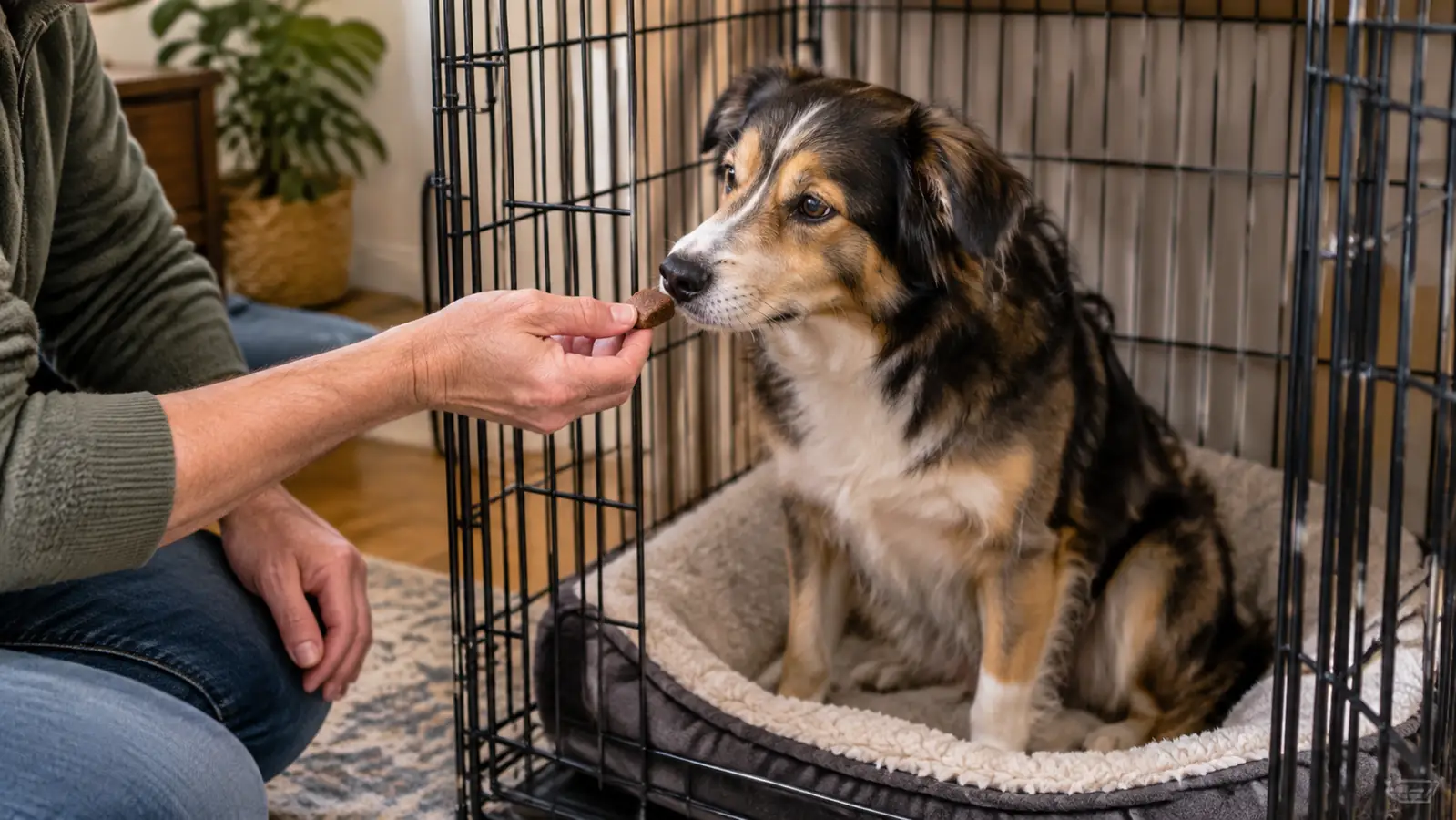
Here is where NaturVet Quiet Moments actually fits. Give it in the same place every time, on the dog's bed or in the crate, with the same small accompaniment: a spoonful of yogurt, a frozen stuffed toy, or a puzzle that takes twenty minutes to finish. The chain matters. Soft chew appears, the body starts to settle, and the brain has a job. I give it after the potty break and before my quiet exit practice, so the dog is not watching me get ready. She is busy with the toy and a calm feeling working its way through.
Do not use the first day as a real test. Give the chew on an evening when you are home and watch what happens. Some dogs yawn, stretch, and fall asleep. Others are barely affected, and I tell clients not to push those dogs into a supplement they do not need. Keep a note: what date, how much, what you saw at thirty minutes and at sixty. After two weeks you will know whether it is helping. If your dog is still agitated at departure, go back to the veterinarian. That is not a failure of the chew. It is a sign that your dog needs more support than anything in the pantry can offer.
One more thing about timing. A chew given only on the days you leave teaches the dog that the chew means goodbye. If you want it to be a calming signal, use it sometimes on ordinary evenings when nobody is going anywhere. The dog learns that this soft treat can appear at any peaceful moment, and that takes the pressure off departures. It becomes part of a calm life, not a warning sign of a lonely afternoon.
What Else Helps
Beyond the chew, I add three supports that cost almost nothing. A fan or white noise machine softens outside sounds that startle a dog awake. A frozen treat in a durable toy gives the dog a job for the first half hour. A covered crate helps a dog who already likes his crate feel like he is in a den. None of these are substitutes for the practice. They make it easier. If you want to compare this whole approach with a wearable option, read my comparison of NaturVet Quiet Moments and a Thundershirt. If you want to see what the chew looked like after months of real daily use, the long term NaturVet review on this site tells that story.
The chew helps the body settle. The practice teaches the brain that you always come back.
Give it a fair chance in the right order
NaturVet Quiet Moments works best when you have already done Steps One through Four. Try the sequence for two weeks, keep a simple log, and see whether the dog settles during your practice departures. If it helps, you have found a piece of the puzzle.
Amazon Check today's price on Amazon →