

I will give you the honest version because the product page will not. When a client mentions a bark collar, my first answer is no, and I have a ten-year shelter background that made me say it faster than most. Most automatic collars punish a symptom and ignore the reason, so a dog goes quiet in the moment and worse in the long run. Last month I agreed to test the FAFAFROG Dog Bark Collar with an open mind, because it does not use a shock, it is completely automatic, and it gives a beep before a vibration. I kept it for three weeks, used it on my own dog June and on two client dogs whose owners were already leaning toward that design, and I wrote down what actually happened instead of what I expected.
Here is the sentence you will not find on the box: a bark collar should be a temporary management tool, not the whole plan. FAFAFROG does not teach a dog to be calm. It interrupts an already running habit, and that difference matters more than any setting on the collar.
The Quick Verdict
A no shock automatic collar that can interrupt pointless alarm barking for three or four weeks while you train a quiet settle. It is not for anxious dogs, it has no remote, and it should never replace changing the reason your dog barks.
Amazon Check Today's Price →The Automatic Bark Collar I Could Defend: No Remote, No Shock
The FAFAFROG listens for the vibration of your dog's bark, sounds a beep, and only then vibrates. It is not a fix for fear and it is not a trainer, but it is a fair interruption for a dog that barks from habit. If you want a collar you can explain to a veterinarian, this is the type to look at.
Amazon Check Today's Price on Amazon →First, What This Collar Is Not
FAFAFROG is not a remote training collar. There is no transmitter to keep in your pocket and no button to press. You fit the collar, choose the level, and leave it alone. The collar detects the vibration of the vocal cords every time the dog barks. If the bark continues past the beep, it adds a vibration. That is the whole system.
The automatic feature has a real strength and a real weakness. Because no human is in the loop, the timing stays consistent all day, and consistency is the thing a tired owner cannot supply. But the collar cannot tell a demand bark from a fear bark or a play bark. It hears bark, and it answers. That is why the collar is better for a dog home alone than for a dog with an audience at the front window.
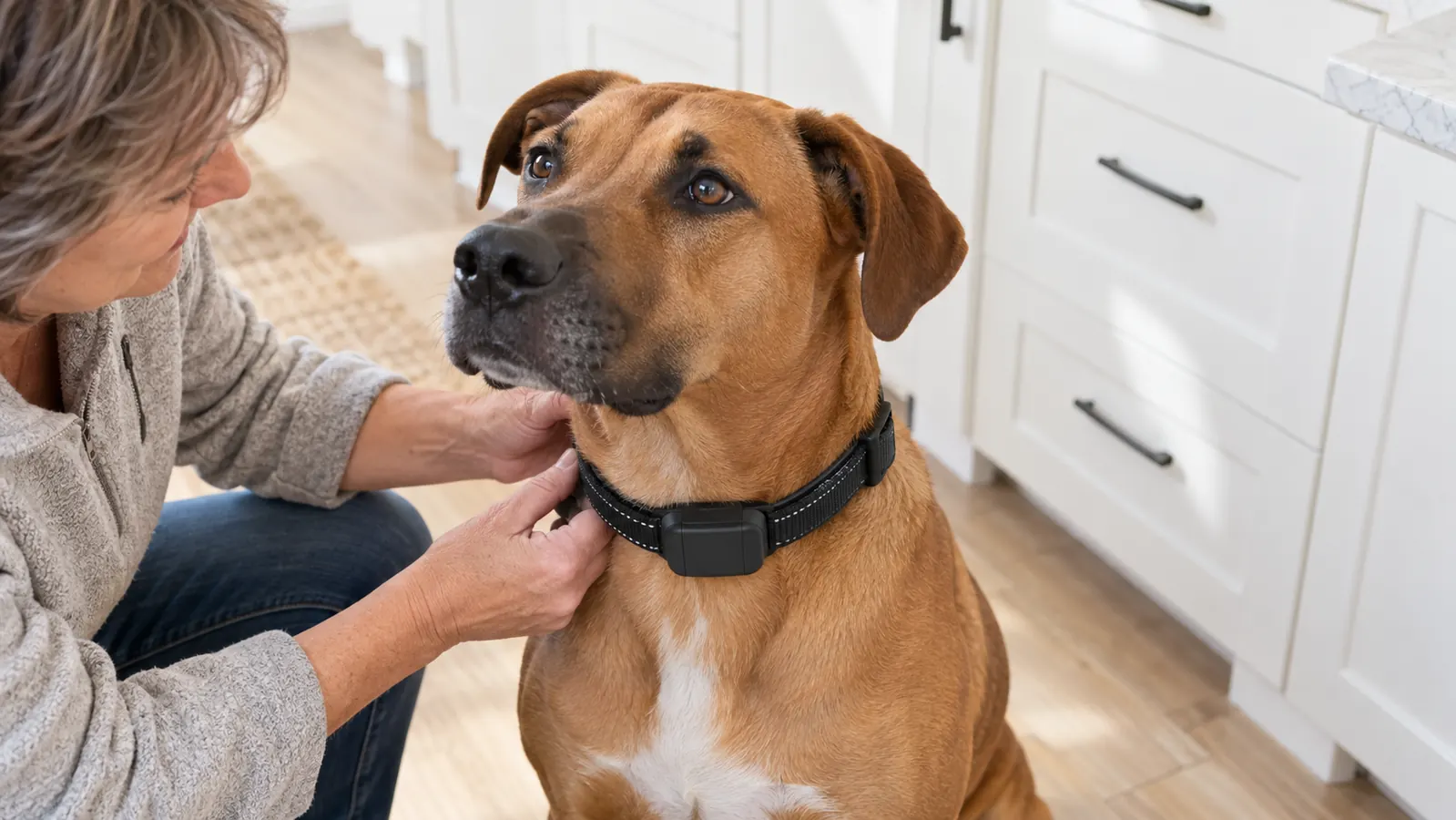
It is also not a shock collar. I put that in the first section because it is the first thing skeptical owners ask me. The correction is a beep followed by a vibration, similar to a phone on a table. June flinched the first time it went off, but she did not yelp and she did not try to rub it off. By day three she put her head through it willingly, which told me she did not find the experience overwhelming.
How I Tested It
I tested it the way I test most training tools: on my own dog first, then with clients whose dogs matched the situation, and always with a notebook. June is a four-year-old, 62 pound shepherd and lab looking shelter mix. She is easy in the house and crate trained, but she treats the living room window like a guard post. When I load the hatchback for client visits, she parks herself on the sofa and barks at every dog, bike, and truck that goes down our road.
For the first week I used the collar on June for exactly twenty minutes after breakfast, which is the window when I am at the sink and she is loose. I set the level low, made sure the collar sat snug high on her neck, and kept a log of every bark, the trigger, and how long she stayed quiet. For the second week I worked with two client dogs, a three-year-old cattle dog mix and a nine-year-old beagle, because the owners had already bought the same collar and wanted me to watch the first sessions. Each collar session ran no more than two hours. In the third week I took the collar off all three dogs and watched whether the behavior stayed changed.
The most useful lesson came from fit. A bark collar has to sit high and snug, not like a regular flat collar. On June it stayed put after the first day. On the cattle dog, who has a denser coat, the collar drifted down twice during a session, and both times he barked without the beep. I tightened it, but it reminded me that a collar can only correct what it can sense.
Where It Worked
For June, the FAFAFROG did more than I expected. Her window bark is pure rehearsal: she sees a dog, she runs to the window, and she barks until the dog passes. On day one, the vibration interrupted that sequence in about four seconds. On day four, she lay down on the rug after the beep and did not get up. That is not a cured dog. That is a dog who has stopped practicing the habit, and stopping the practice is the first real step in changing it.
I kept the collar on June for six more sessions after day four, not because she needed them, but because I wanted to see whether the interruption would hold when the trigger changed. It did not hold perfectly. On day six, a loose dog came down the sidewalk and June charged the window before the collar could beep. The collar stopped her after two barks instead of before the first one. That felt more honest than the perfect day four, and it is the number I tell owners to expect from any automatic collar.
The beagle was a more interesting success because the collar was never the main fix. Her owner and I realized the barking peaked in the hour before she came home, and the dog was bored more than alarmed. The FAFAFROG broke the immediate loop, and the short walk and a frozen stuffed toy filled the empty hour. By the third week she was choosing her mat by the window instead of racing to the sill. The collar bought us the quiet we needed to build the routine.
Where It Got Complicated
The cattle dog is the reason I will not call this a fix for every barking dog. He did not bark from boredom. He barked because he was frustrated by a fence and by being left in the yard while other dogs walked past. He was already tense when the collar went on. The vibration stopped him for a few seconds, but his ears stayed flat and his tail dropped. On the third morning he started whining before he even reached the front window. That is the opposite of calm. I told his owner to take the collar off, cover the bottom half of the window, and take him for a real walk before leaving for work.
Automatic collars run into a wall with fear based barking. Let me say this plainly. If a dog is scared of the mail carrier, the dog is not choosing to bark. The dog is asking the carrier to go away. Adding a vibration to that moment can teach the dog that the window itself is frightening, because the dog cannot follow the logic the way a person can. It can also suppress the warning bark, and a warning bark from a fearful dog is information, not something I want to erase.
I also noticed that the collar works best in short sessions. It looks like something you could put on at breakfast and forget, but after a couple of hours the correction becomes background noise. The dog starts to connect the living room with being vibrated, not the bark with the vibration. That is when a fair tool becomes a confusing one, so I stuck to sessions short enough to mark the quiet afterward.
One technical limitation is worth naming. The collar is triggered by the vibration of the vocal cords, so it only catches a dog who is actively barking. It will not catch the hard stare, the lifted lip, or the low growl that happens just before the bark, and that is exactly the moment I want to reward. For June, that meant a few missed chances early on. I do not count that as a defect. It is the boundary of any automatic collar, and it is another reason the collar belongs in a short term plan, not a permanent routine.
The Pros and Cons, Without the Marketing
What I Liked
- Beep first and vibration second gives a clear warning before any correction.
- No shock and no remote, which makes it easier to defend to a skeptical owner.
- Interrupted a rehearsed window bark by day four in my test.
- Rechargeable design means you are not buying small batteries over and over.
Where It Falls Short
- It does not teach a calmer alternative, so the barking can come back when the collar comes off.
- It can make fear and barrier frustration worse if you put it on the wrong dog.
- The fit has to be precise, and precision is harder with a thick coat or a dog that rolls and shakes.
- There is no way to reward quiet, so the collar cannot do the job alone.
By day four June lay down at the window instead of charging it. That quiet was the most useful proof I saw all month, and it was also the limit of the proof. Suppression is not the same as calm.

Who This Is For
Buy the FAFAFROG if a veterinarian has cleared your dog, the barking happens mostly when the dog is alone indoors, and you can be home for the first few days to watch how your dog reacts. The dog it fits best is an alarm barker who is otherwise relaxed, with loose ears and a loose tail. The collar can help when you need a few quiet weeks to retrain the routine.
It is also for owners who have already said no to shock collars. That decision matters. There are fewer no shock automatic options than the ads suggest, and the FAFAFROG deserves credit for not crossing that line. I still would not use it longer than a few weeks, and I would pair it with a mat command and a place where the dog can settle with something to chew.
Who Should Skip It
Do not buy this for a dog that panics when you leave. Separation distress may look like barking, but it is not barking. If the dog drools, paces, shreds the edge of the door, or has accidents when alone, a collar is management without a diagnosis, and it can hide what your veterinarian needs to see. The same goes for thunder phobia and fear of strangers.
Skip it if the dog reacts to the sight of other dogs with stiffness, growling, or hard staring. That dog is over threshold, and adding a vibration to an over threshold animal does not make the trigger less important. Move the dog away, change the environment, and ask a professional before you put anything around the neck.
What I Would Try Before Buying Any Collar
Before you order, spend three normal days counting the barking. Put an old phone or a small camera where you can see the window, then write down what the dog barks at, when, and for how long. Most owners are surprised to see that the barking is not as constant as it feels from the other room. If it is only ten minutes in the morning and ten in the evening, solve that with a covered window and a frozen stuffed toy. No collar required.
If the count is high and the dog is otherwise relaxed, teach a settle cue before you add the collar. Put a mat in a corner away from the window, reward four paws on the mat, and give the dog a task. I know a week of that feels slow, and I know ordering a collar takes nine seconds. But the week sticks after the collar is back in the drawer, and the collar only works while it is on.
The Bottom Line
The FAFAFROG bark collar is an honest piece of hardware with an honest limit. It interrupts a habit, but it does not teach a new one. For a dog whose barking is pure rehearsal, that interruption is enough to break the loop. For a dog whose barking comes from fear or frustration, it can make things worse, and decent design does not change that. I used it for three weeks, and I saw one clear success, one partial success, and one dog I pulled it off after three days. I would only buy it again for the narrow situation I described, and I would never hand it to someone without talking about the reason behind the barking first.
June has been wearing a flat collar for the last week, and the window routine is not gone. It is quieter and shorter. When she does run to the sill now, I call her back to the mat and she gets the treat she has learned to expect. The FAFAFROG did not create that. It gave us enough silence to practice it.
The Best Reason to Look at Today's Price
If your dog is the habitual indoor barker I described and you want a no shock, no remote tool to stop the rehearsal while you train the calm, the FAFAFROG is worth your short list. It is not right for every dog, and the decision should stay with you and your vet.
Amazon Check Today's Price on Amazon →