
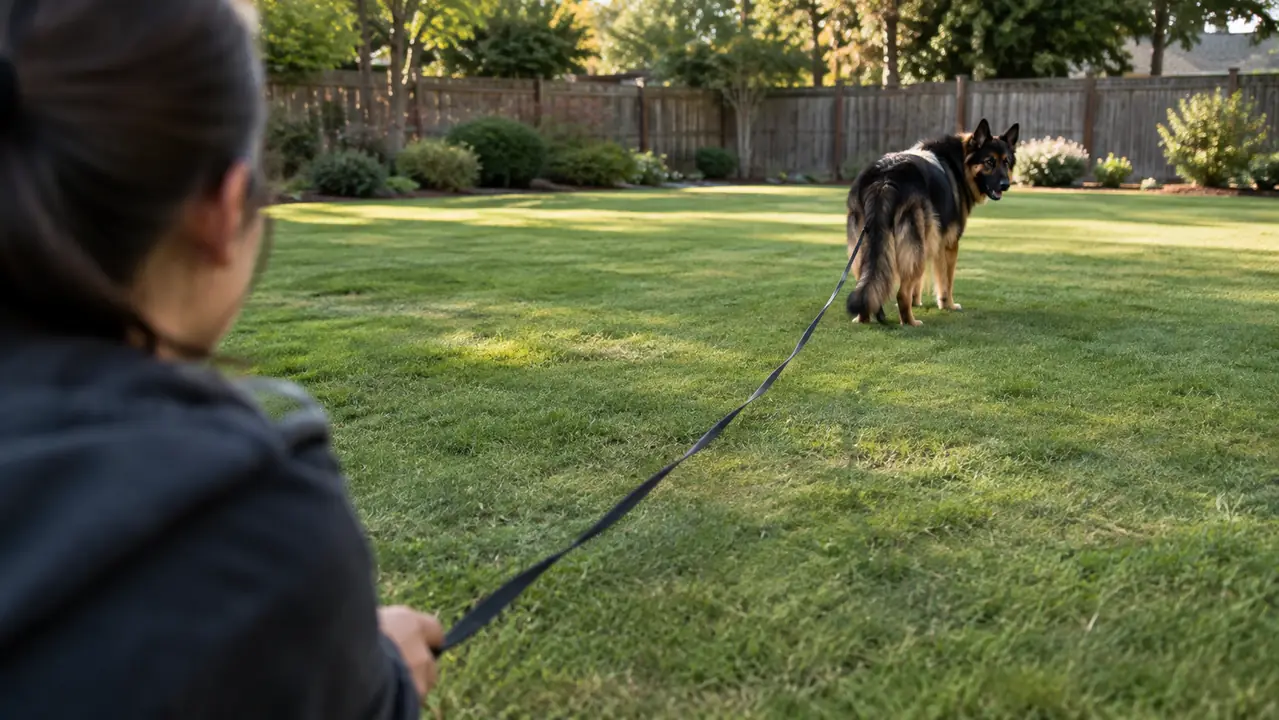
When people ask me for an honest review of the Hi Kiss training lead, I usually tell them to take it into the backyard before they judge it. A 20 foot line sounds like the simplest piece of gear you can buy, and it is. But most of what you read about long lines leaves out what it feels like the first time your dog actually hits the end of one. This review comes after four months of weekly recall sessions with my own dog June, a 62 pound shepherd-lab mix, and after handing the same line to more clients than I can count.
What nobody tells you is that this is not a retractable leash, and it does not have a brake or a lock. The Hi Kiss line is exactly what the title says: one straight 20 foot length, a clip on the dog's end, a loop on yours. When your dog runs, the line runs right along with them. When they reach the far end, they feel a sudden stop. Your job is to be holding the loop when that happens, or to step on the dragging line at the right moment. That paragraph is the whole method behind a long line, and it is why so many people buy one and then never use it.
The Quick Verdict
A simple, honest 20 foot line that does its job. It will not teach your dog to come, and it will not fix pulling on a walk. What it does is give you a safe way to practice recall at real distance, which is exactly what most young dogs need.
Amazon Check Today's Price →If you are buying your first long line, this is the one I hand people first
It is long enough for real distance work, short enough to manage in a backyard, and simple enough that you cannot accidentally overcomplicate your training. That combination is harder to find than you would think.
Amazon Check Today's Price on Amazon →How I Have Used It
June is the reason I own a long line at all. She is 62 pounds, probably shepherd and lab in some shelter-issue mix, and she pulls hard enough on a flat collar to make a walk feel like a water ski session. Her recall is perfect in the kitchen and imaginary at the far end of the yard, which is the exact pattern I see in client dogs all the time. The dog is not stubborn. The distance is just new.
Most of our long line sessions are boring on purpose. I clip the line to a harness, let June wander until the line goes slack and then taut, and I wait. When I call her and she does not come, I do not yank or yell. I walk toward her, gathering the line hand over hand until she is close enough to remember that listening to me pays. Then I release her and we do it again. That repetition is the whole lesson.
I have also used this exact line with client dogs, and I keep one coiled in my hatchback for that reason. When a family says they are afraid to let their puppy off lead even in an empty soccer field, this is the tool I hand them. It is not magic. It does not replace a single training session. It simply makes those sessions possible in places where a mistake would otherwise mean a lost dog.
For anyone new to this, here is what a session looks like with us. I bring June into the yard on the line and let her wander ahead. I wait until she is distracted by something, usually a smell in the grass. Then I call her name once, maybe twice. If she looks my way, I turn and jog a few steps to make come a movement instead of a demand. When she does come, the line goes slack and she gets a quiet good girl and a release back to sniffing.
What Nobody Tells You About a 20 Foot Line
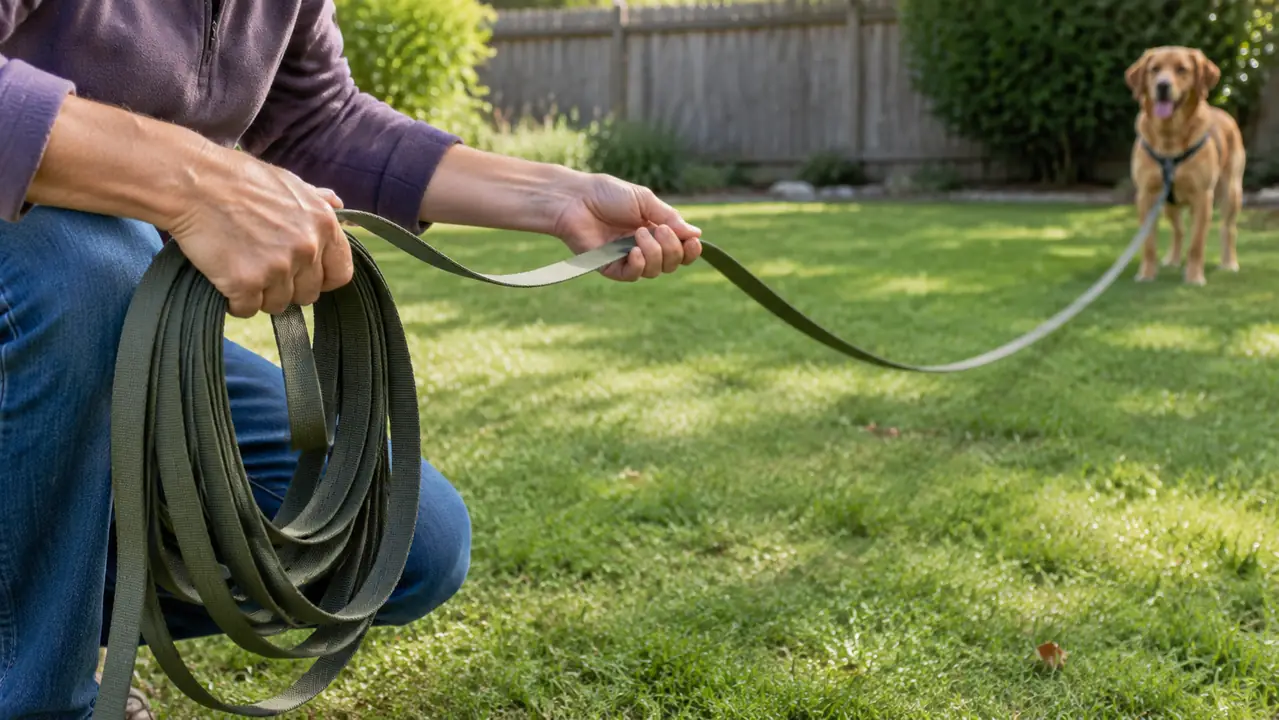
The first thing a review can tell you that a product listing cannot is what 20 feet actually feels like. Twenty feet is not twice as good as a 6 foot leash. It is a different animal. Your dog can reach the end of your yard, the neighbor's hedge, and three things you do not want them to meet before you have time to take a step. That freedom is the point, but it is also the risk.
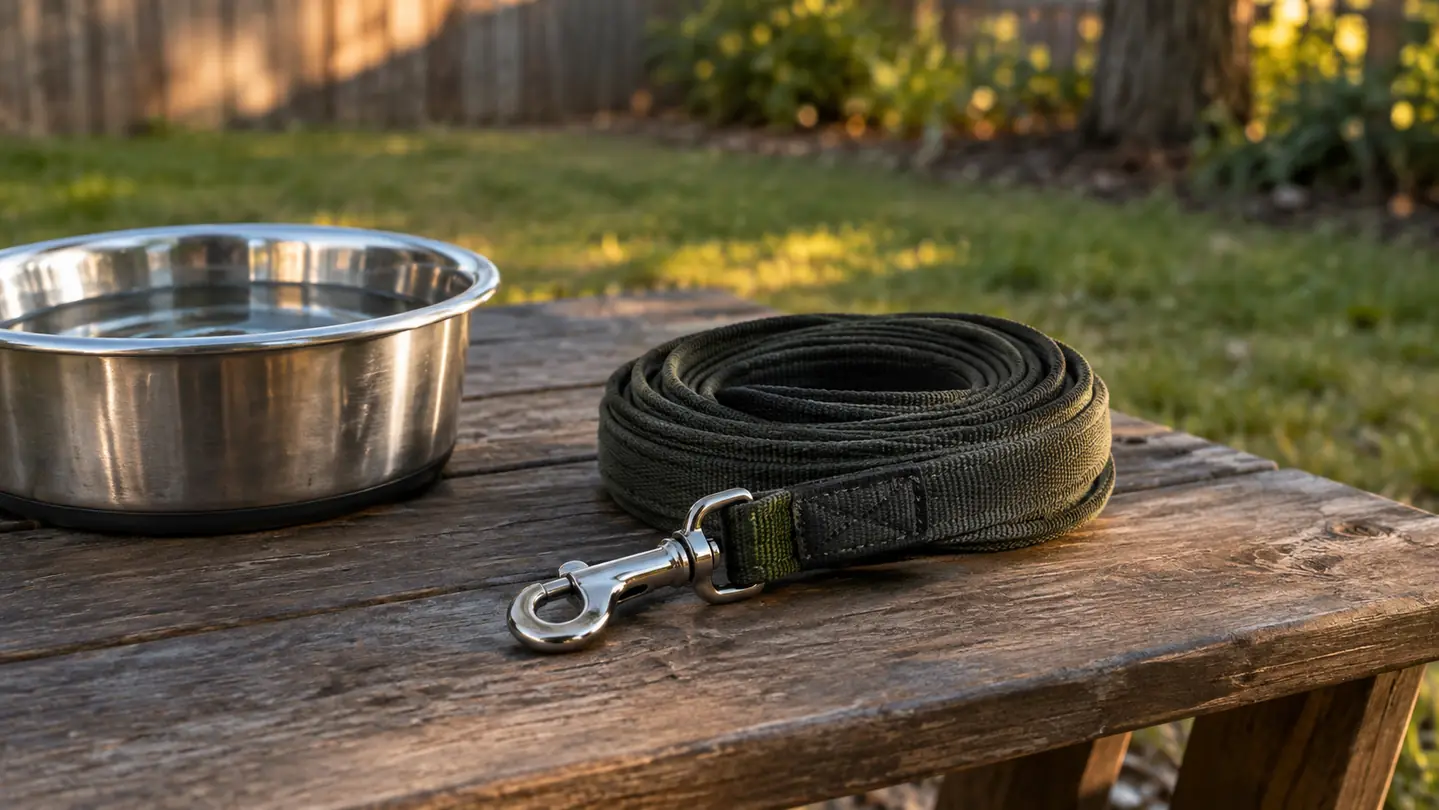
The second thing is the clip. On this line, the hardware at the dog's end is the thinnest part of the system, and it deserves a once-over before every use. I check mine the way I check a seat belt latch: quick, automatic, every single time. I am looking for a bent hinge, a stiff swivel, or a rough edge where the collar ring sits. After months of use, my clip is still straight. On a line this inexpensive, that has been a pleasant surprise.
The third thing nobody tells you is that the line can burn your hand when a dog hits the end. The first time June reached the end of the line at full speed, I was holding the loop with one bare hand and I felt all 62 pounds arrive at once. Now I wear a leather glove for the first few minutes of any session near a squirrel. That is not a complaint about the product. It is just what happens when you give a dog twenty feet of freedom.
The last thing I will say before the glowing part is this: never leave a dog wearing this line unattended. It is a training line, not a tether. If June drags it into the yard and wraps it around a bush, she can get stuck. If she wraps it around a deck post at speed, she can hurt herself. I use it only when I am outside with her, and I take it off the moment we are done. The line is a helper, not a babysitter.
One more practical warning: a 20 foot line will find every bush, branch, and garden gnome in your yard. There will be moments when you spend more time untangling the line than training with it. That improves with practice. You learn to keep the line off the ground when you are moving, and you learn to walk toward the tangle instead of pulling against it. The tangle is not a defect in the Hi Kiss line. It is the nature of any long line.
Where the Hi Kiss Line Earns Its Keep
Now for the part that makes me keep recommending it. The Hi Kiss line is the most reliable way I know to let a young dog be wrong about recall at a real distance and live to learn from it. Recall cannot be trained on a 6 foot leash. The dog has to have room to choose you over the squirrel, and you have to have a way to end the chase before it becomes a game. The line is that way.
It earns its keep in the fenced yard too. I have a half acre with a fence I trust, and I still use the line at least twice a week. The fence keeps June inside. It does not teach her to come when I call. The line lets me practice the exact moment where her recall falls apart: she is at the far end, she has found a smell, and I am not important. When she reaches the end of the line and the smell does not go anywhere, she turns around. That is the beginning of a reliable recall.
Twenty feet is the sweet spot. Shorter lines do not give the dog room to forget you, and longer lines spend half the session wrapped around a tree or coiled on the grass like a snake. At 20 feet, I can stand at one edge of the yard and let June find the other edge. That is enough distance for a squirrel to appear and for her to make a choice, and it is short enough for me to reach her before she reaches trouble.
There is one more reason I reach for this line instead of a retractable leash, and it matters more than the length. A retractable leash is always under tension, which teaches a dog to pull against a constant pressure. A long line lies on the ground and gives nothing until the very end. That difference is why dogs often walk better after work on a long line: they learn that slack feels normal and pressure means stop.
I always use this line on a harness, never a flat collar. A dog that hits the end of a 20 foot line at full speed can put a lot of force on its neck. June has a sturdy front clip harness for walks, and I use the same one for long line work. It gives me control without teaching her that pressure around her throat means anything at all.
What I Would Change
If I could change one thing about this lead, it would be the clip. I want a larger, sturdier snap with a swivel, the kind you see on a working livestock lead. The included clip is fine for a 62 pound dog on grass, but I would not trust it on a strong 90 pound dog who hits the end of the line with everything they have. That is not a deal breaker for me, but it is a detail worth knowing before you buy.
The second thing I would change is the absence of a midpoint loop. If you have a space that is only 12 feet long, you have to wrap the extra 8 feet around your hand or tie a knot in the line. A simple second loop at the 12 foot mark would let me shorten the working length without creating a knot that snags on everything. As it is, I manage by clipping a carabiner to the line, which works but adds an extra piece of hardware to lose.
Those are small complaints. The line has held up through a wet Missouri spring, a summer of evening sessions, and more snags than I care to admit. I have washed it in a bucket of water with dish soap, hung it over the fence to dry, and it looks the same as the day it arrived.
What I Liked
- True 20 foot working length for distance recall practice
- No tension until the dog reaches the end, so it rewards slack
- Lightweight and easy to coil into a small bag
- Simple enough that there is nothing to break or adjust
- Inexpensive enough to keep a spare in the car
Where It Falls Short
- Small clip that needs a check before every session
- No brake or lock, so you have to hold the other end
- Drags and snags on anything except open ground
- Not for tying out or leaving a dog unattended
- Needs a harness and a plan, not just a longer leash
The line has not made June perfect. It has made it possible for her to practice being wrong at a distance, and that is where every recall is actually learned.
Who This Is For
This lead is for the owner who has a young dog, a fenced yard, and fifteen minutes a week to practice something that feels like nothing is happening. It is for the person who is tired of shouting come from the porch and watching a dog sniff the same spot for two minutes. If that sounds like your kitchen table, the Hi Kiss line will earn its place in your drawer faster than most equipment I recommend.
It is also for people who want to avoid retractable leashes but still want to give a dog more room than a six footer allows. You cannot teach a dependable recall on a short leash, and you cannot practice it safely with a retractable cable that keeps constant tension. A long line is the middle path, and this one is a good example of that middle path.
Who Should Skip It
Skip this lead if your real problem is pulling on a neighborhood walk. The line will not fix that. In fact, it can make things worse if you use it for a walk, because every time you let the dog get to the end and stop, you are silently practicing that running into the end is no big deal. Pulling gets fixed on a short leash with a front clip harness, not on a longer leash.
Skip it if your yard is smaller than the line or if you have no way to practice safely. A 20 foot line in a small paved yard is a tripping hazard, not a training tool. And skip it if you are not willing to practice at least twice a week. The line only works as part of a drill. If you are looking for a product that does the training for you, this is not that product, and I would not try to sell you one that claims to be.
The bottom line, if I had to say it in one sentence: the Hi Kiss lead is not exciting, not clever, and not a shortcut. It is a long, honest piece of training gear that does exactly what a long line is supposed to do, as long as you are willing to do the practice. For most dogs under two years old, that is the right tool at the right time. For me, it is the one I hand to clients first.
The bottom line from someone who uses this line with clients and her own dog
The Hi Kiss lead is a good, honest tool for one real job: practicing recall at distance. If that is what you need, give it a place in your drawer. If you are hoping for a retractable fix that does the work for you, keep walking.
Amazon Check Today's Price on Amazon →