
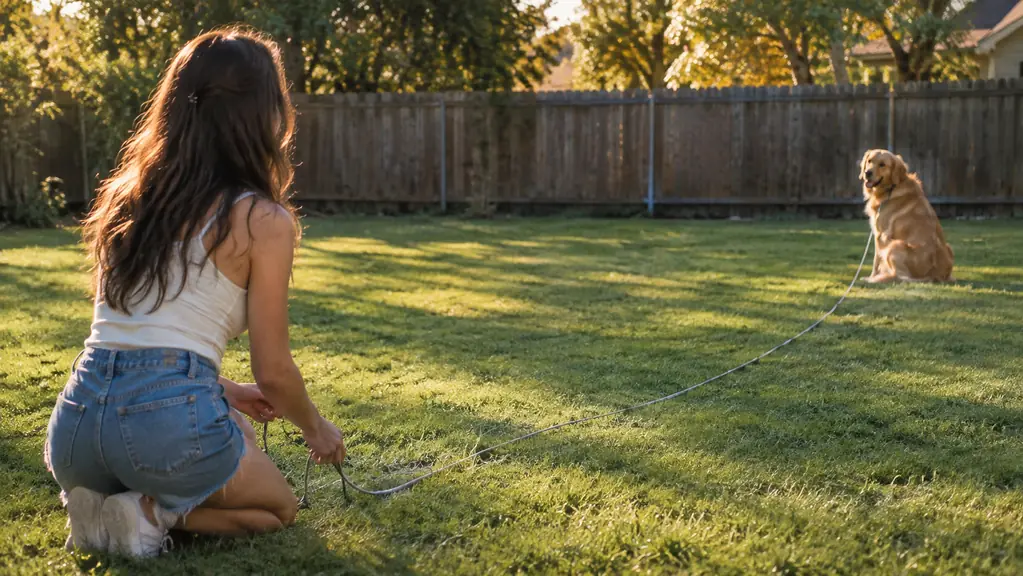
I was a long line skeptic for years. In dog training we ask a lot of ordinary owners, and telling someone to buy another piece of gear after a basic leash did not fix recall feels like selling snake oil. But recall happens at a distance, and distance needs a line long enough to matter. This past season, I used a Hi Kiss 20 foot training lead almost every day with my own dog June. It became one of the few training tools I recommend without apologizing.
Before you picture a retractable leash, stop right there. The Hi Kiss lead is not retractable. It is one long, plain 20 foot line that lies on the grass or trails beside your dog until you gather it in. That simplicity is the reason it works for recall. You get real distance, you get a visible boundary you can step on when you need to, and you give your dog a chance to choose to come back instead of being snapped back by a mechanism.
The Quick Verdict
A simple 20 foot line that does the one job it is designed for. It will not fix pulling on walks, but it is the most direct training tool I know for practicing recall at a real distance.
Amazon Check Today's Price →Practice the Recall Where It Falls Apart
If your dog listens in the kitchen but checks out at the fence, this is the tool I would start with. Hi Kiss makes a no frills version that survived a full season in my yard.
Amazon Check Today's Price on Amazon →How I've Used It
June is a 62 pound shepherd-lab mix, four years old, and she has her opinions about distance. She is calm in the house and crate trained, but in the yard her nose takes over. Early in the season, she would hear me call and then stand at the fence pretending I did not exist. Feeding her inside a crate had not translated into coming when called outside. No piece of gear fixes that overnight.
Most sessions happened in my fenced half acre on the edge of Springfield, Missouri. I used the Hi Kiss line at the end of the day when the yard was quiet. I asked June to wait by the porch, carried the far end of the line to the fence across the yard, planted my feet, and called her once. Then I gathered the line in hand over hand as she came, and I let the last few feet drag so she never learned to brace against pressure.
The line measured a true 20 feet, and that mattered in a way I did not expect. At eight feet she is a different dog than at twenty. With the long line she had room to make a wrong turn, feel me stop my feet, and correct herself before she reached the edge. By midsummer, I was using calls at fifteen and twenty feet instead of drills at five.
The biggest mistake I made early on was waiting too long to increase the distance. It felt safe to drill at five feet, but five feet did not teach anything. Once I trusted the line and let June get to the end of it, she started to learn what a real recall feels like.
Because June is a strong dog, I was careful about what I clipped the line to. A long line is not a thing you yank, and I used a flat collar, never anything that would dig in if she hit the end at speed. If your dog has a sensitive neck, work on a front clip harness before you move to a long line.
One more habit saved me a lot of trouble. I never left the line attached to June when she was loose in the yard by herself. A training line is for active sessions, not for unattended wandering. I hung it on a hook by the back door after every use, and I will not pretend I did not lose an afternoon to untangling it in week one.
What a Long Line Does That a Six Foot Leash Cannot
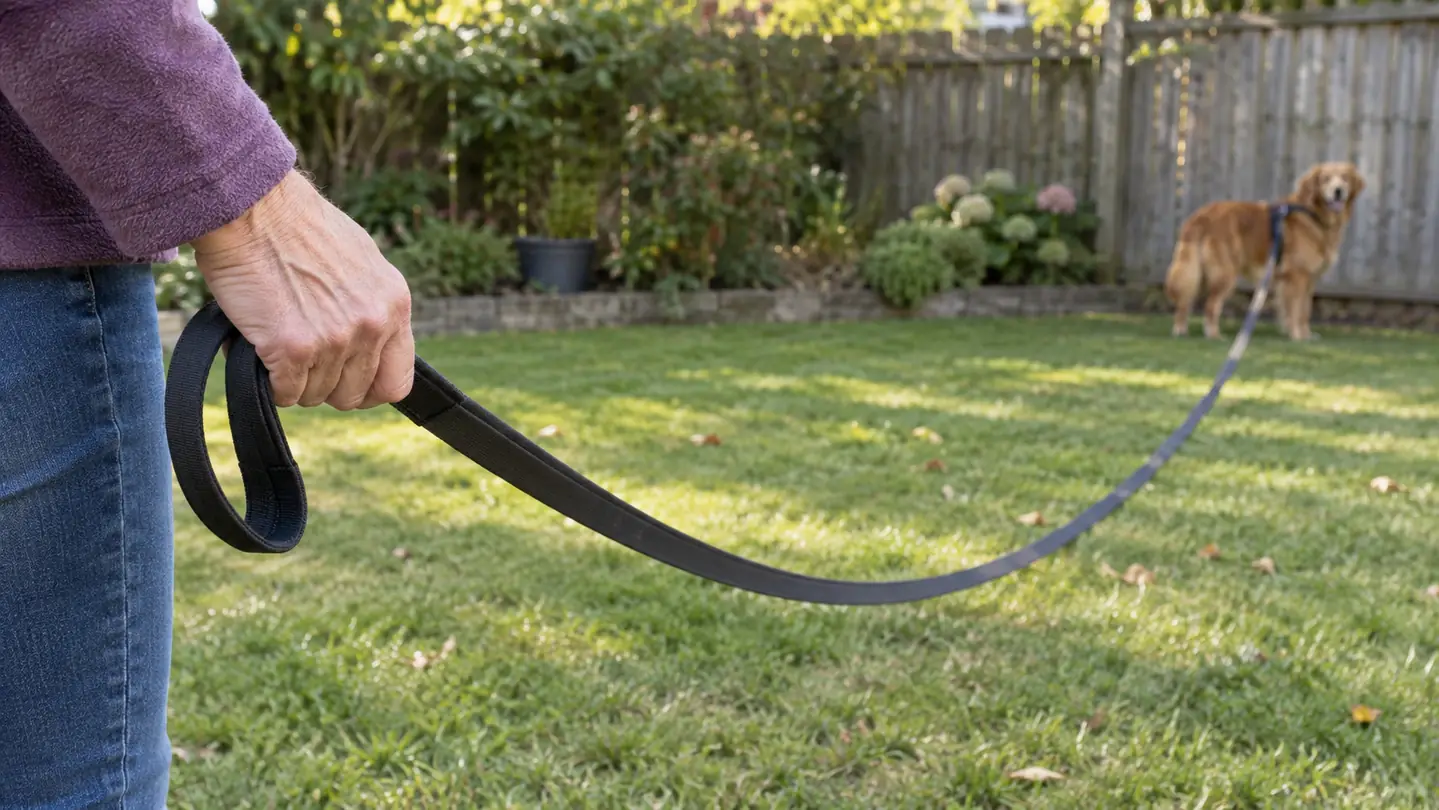
A long line buys you one thing: space to teach a behavior where it is hardest. In a normal six foot session, the dog never gets far enough from me to practice ignoring a distraction. The minute they do, I am at the end of the leash pulling. A 20 foot line changes that. It lets me send the same exercise all the way to the fence line, where a squirrel or a scent really matters, and still keep a hand on the outcome.
I also use the line to teach the dog to choose a handler over a trigger. When June stays at the fence instead of coming, the line does not yank her to me. It simply stops her from practicing the wrong response. I go out, gather the line, and we try again. Over time the choice happens earlier and earlier, until I am mostly a passenger.
This is not magic. The line works because it keeps the dog safe while they learn to be wrong. Without it, a young dog can take off after a rabbit and discover that running away is fun. With it, that same dog gets twenty feet of freedom and a clear stop that does not hurt.
When I work with owners, I compare a long line to a seat belt for the early miles. Nobody wants to always drive that way, but it lets a learner make safe mistakes long enough to build good judgment. The same idea applies to recall. If you are nervous that your dog might not come, you shorten the distance before you use the long line, and the line gives you a chance to practice without your heart dropping.
I started every session with the same question: does June turn her head when I say her name? If the answer was no, I shortened the distance. If the answer was yes, I stayed at that distance until the turn happened every time. The long line let me move back a few feet each week without starting over.
Hardware That Survived a Season
I am hard on training gear. This line spent a whole season being stepped on, dragged through wet grass, and draped over the porch rail to dry. The clip stayed attached, the line did not stretch into a spring, and after a bucket rinse it looked ready for the next dog. I did not need to replace it midsession, and for a tool that gets this much abuse, that is the review that matters.
One warning matters more than any feature: this is not a tie out. It has no locking handle and no brake to hold a dog that is running. If you attach the line around a fence post and walk away, you are setting up a tangle or a fall. Use it in a session where you hold the handle and stay present.
Managing the line took me about ten minutes to get used to. I gather it in loose figure eights, not a tight coil, so it releases cleanly on the next throw. When she returns faster than I expect, I let the extra line fall onto the grass and step on the part near me. That does not hurt the dog, but it keeps the recall from becoming a chase.
How do I know it is still in good shape? I ran my hand down the whole length before each session, checking for weak spots and rough places. The line ended the season feeling the way it did when I took it out of the package. That is not praise I give every piece of gear.
How Recall Actually Improved
I did not expect a new line to change June's behavior, and in the first month it did not. The change came from repetition at longer and longer distances. I scheduled short three minute sessions most evenings, always ending before she got bored. Somewhere around week six, I saw her decision get earlier. She hears the call, she pauses, and she comes back on a loose line more often than she used to.
Did it make her perfect? No. A neighbor's dog barked through the fence one evening and June did not come back for forty seconds. That is information, not failure. It told me we were still working at the edge of her limit. We moved the practice farther from the fence the next week.
The line also made it possible for my clients' dogs to improve. I am a trainer, but I am reluctant to sell equipment from my trunk. Still, for recall work in a normal backyard, I tell them the same thing I did: buy a plain long line, use it in short sessions, and do not expect it to fix walking on a loose leash. When the tool does one job well, that is enough.
One evening in September the rain had stopped, and I decided to risk one short session. June was out of practice for a week and I expected a slow response. Instead, I called her from the far side of the yard and she came all the way back, sat at my feet, and looked up like she had known it all along.
By the end I was not using the line to stop June. Most rehearsals took place at the full 20 feet, and she was coming back before the line went tight. I still carried the line because it allowed me to practice without worry. The day I stopped carrying it, I knew I had gotten my money's worth.
In week one, June stood at the back fence pretending not to hear me. By the end of the season she was turning around before I got the rest of her name out.
Why a 20 Foot Line Is Not a Walking Leash
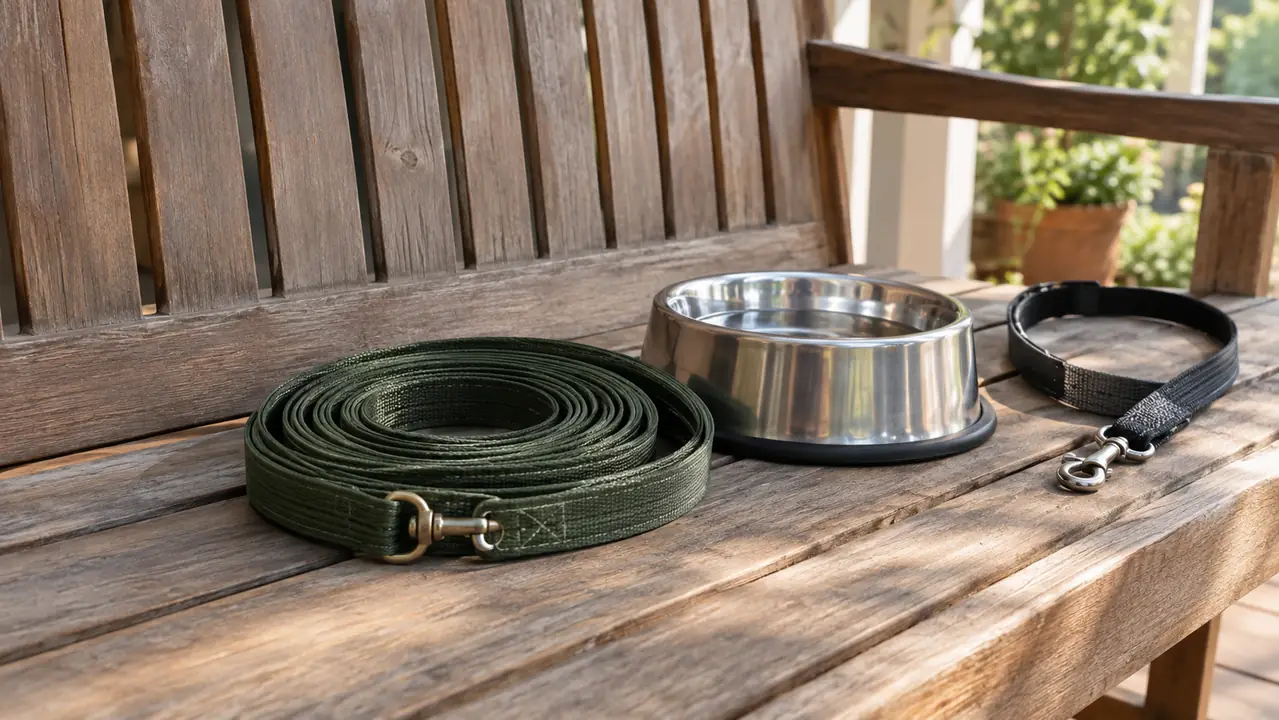
If you came to this review because your dog pulls on a normal walk, stop reading and skip this product. A long line gives a pulling dog more room to build speed, and that is exactly the opposite of what a walk needs. For daily walks, I reach for a front clip harness or a shorter leash. The Hi Kiss line lives in my yard bag, not on the trail.
People also ask whether they can use one at a park. You can, if the space is empty. The risk with a long line in a public place is that another dog can run across it, and a sudden catch at speed can hurt both animals. I keep long line work in my fenced yard.
A long line is also a poor choice for sidewalk training because of the people and bikes. In a tight space, the extra line is a tripping hazard. I know because I tripped over my own line once in the driveway, and that was the end of that experiment.
I also want to say clearly that a long line should never be part of public leash laws. If you walk a town sidewalk, a long line is legally questionable and plenty of people will read it as an uncontrolled dog. Keep long line work in your own fence or an empty field.
What I Liked
- Twenty real feet of distance, not just a few extra inches
- Simple and sturdy, with no battery, remote, or mechanism to fail
- Easy to wash after a muddy session
- Lightweight enough to carry in a tote or hang on a hook
- Enough line to step on when the dog ignores the first call
Where It Falls Short
- Not a no pull walking leash, and it can reward pulling if used on a walk
- No locking handle, so it requires both hands and attention
- Must be managed between reps or it tangles around dog legs and yard furniture
- Will not teach recall by itself. The practice still has to happen
Who This Is For
I would put the Hi Kiss long line in the hands of an owner who has a fenced area, a dog that knows sit and down and comes when called in the house, and one specific goal: making that recall hold up at distance. If that is you, buy the line and plan on ten focused minutes most evenings.
You do not need professional training experience. You need a quiet space, a pocket of small treats, and the patience to end a session before your dog gets bored. I would guess most of my clients could see progress within a month if they practiced three or four times a week.
Who Should Skip It
Skip the Hi Kiss line if your real problem is pulling on a sidewalk. A long line gives a puller a longer runway, and it is the wrong medicine for leash manners. Skip it too if your dog already has dependable recall in open spaces. The line would only add a step you no longer need.
I would also be careful if your dog barks or lunges at other dogs across the street. A twenty foot line gives a reactive dog more space to rehearse that behavior and more speed when they hit the end of the line. For leash reactivity, start with management and a trainer who can watch the body language, not a longer line.
And if you are looking for a product that will do the training for you while you stand there, this is not that product. A long line is a simple piece of equipment. The work is still yours.
Give Your Dog the One Thing a 6 Foot Leash Cannot
After a season of daily use, the Hi Kiss long line earned its place in my yard bag. If recall is your project, this is the simplest place to start.
Amazon See Today's Price on Amazon →