
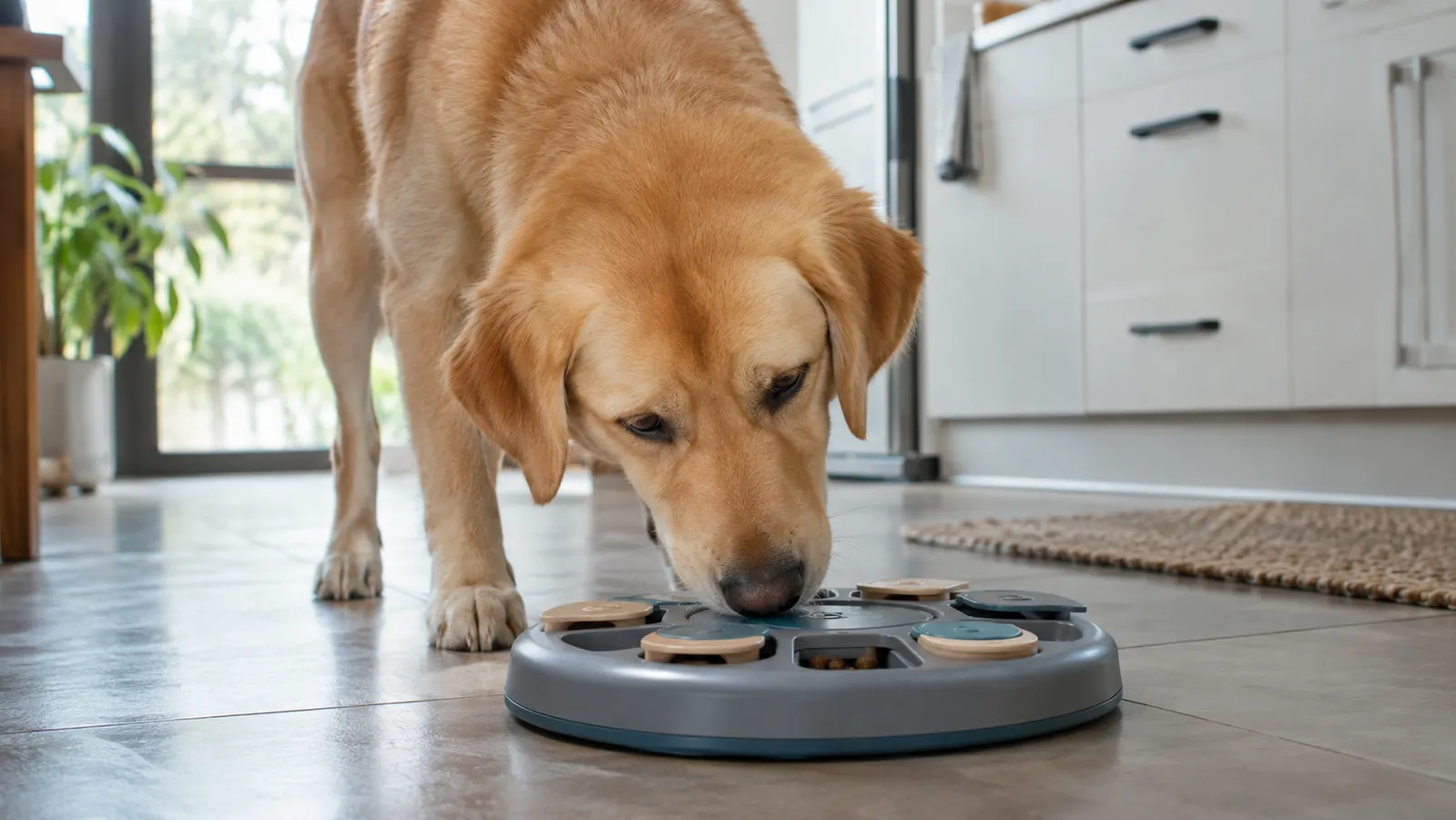
I have to start with a confession, because it shapes everything I say next. After ten years of volunteering in shelters and another four years of going into people's homes as a trainer, I do not believe most dogs need more gear. I have watched owners buy harnesses, calming chews, and puzzle toys hoping one product will make a hard dog easy. Sometimes it works. More often, the product sits in a closet by spring. So when KADTC sent over its 2-level puzzle feeder for an honest review, I told myself I would test it the same way I test everything with my own dog, June, and with client dogs. Here is what I found.
First, a little context about June. She is a 62-pound shepherd-and-lab mix, four years old, and the fastest eater I have ever lived with. Her whole meal is gone in about two minutes, and then she looks at me like I have forgotten the rest of it. She is not anxious, she is not aggressive, she is just a dog who loves food. That makes her a good candidate for a puzzle feeder. If a product can slow her down and keep her busy, it has done its job. I also tried it with three client dogs during the review period, and I kept notes on all of them.
The Quick Verdict
A solid two-level puzzle feeder that slows fast eating and gives most food-motivated dogs a useful job. It will not train a dog or calm an anxious one, but for what it is, it works.
Amazon Check Today's Price →See Today's Price for the KADTC Puzzle Feeder
If your dog eats like there is no tomorrow, this is a better way to serve dinner. Check today's price and read recent owner reviews before deciding.
Amazon Check Today's Price on Amazon →How I've Used It
I started the way the instructions say to start, with the easiest level and no pressure. I filled the small openings with June's regular kibble and a few tiny training treats, then set the whole thing on the kitchen floor. On the first try she nudged the first compartment, pulled out a piece, and looked at me as if to ask if this was allowed. It took her about nine minutes to clear that first level. The next night she was faster, but she was also more interested. That was the first honest sign that this toy had real value.
Within a week, June had learned a route. She could move from the top level down to the lower level without any help from me. That is exactly what I want to see. The point is not to make a meal last forever. The point is to give a smart dog a small job that uses her nose and her paws, so she is not just inhaling kibble from a bowl.
For the client dogs, I did not expect the same result from every dog. One young dog with no puzzle experience needed me to sit beside her and show her where the food was. Another dog, one who had used puzzle toys before, finished the whole thing in about four minutes and then walked around checking every edge for extra treats. That kind of variation is normal. I mention it because many online reviews make it sound like every dog will sit happily for thirty minutes. That is not how it works.
I kept a rough log for the first two weeks because I wanted to be honest about results. Night one took nine minutes. Night three took seven minutes, and two kibble pieces ended up on the floor because I had not pushed them all the way in. By the end of week two, June could clear both levels in about six minutes, but she still stopped to sniff each corner and check for anything I had missed. Watching her work was genuinely interesting. She was not just eating, she was making decisions.
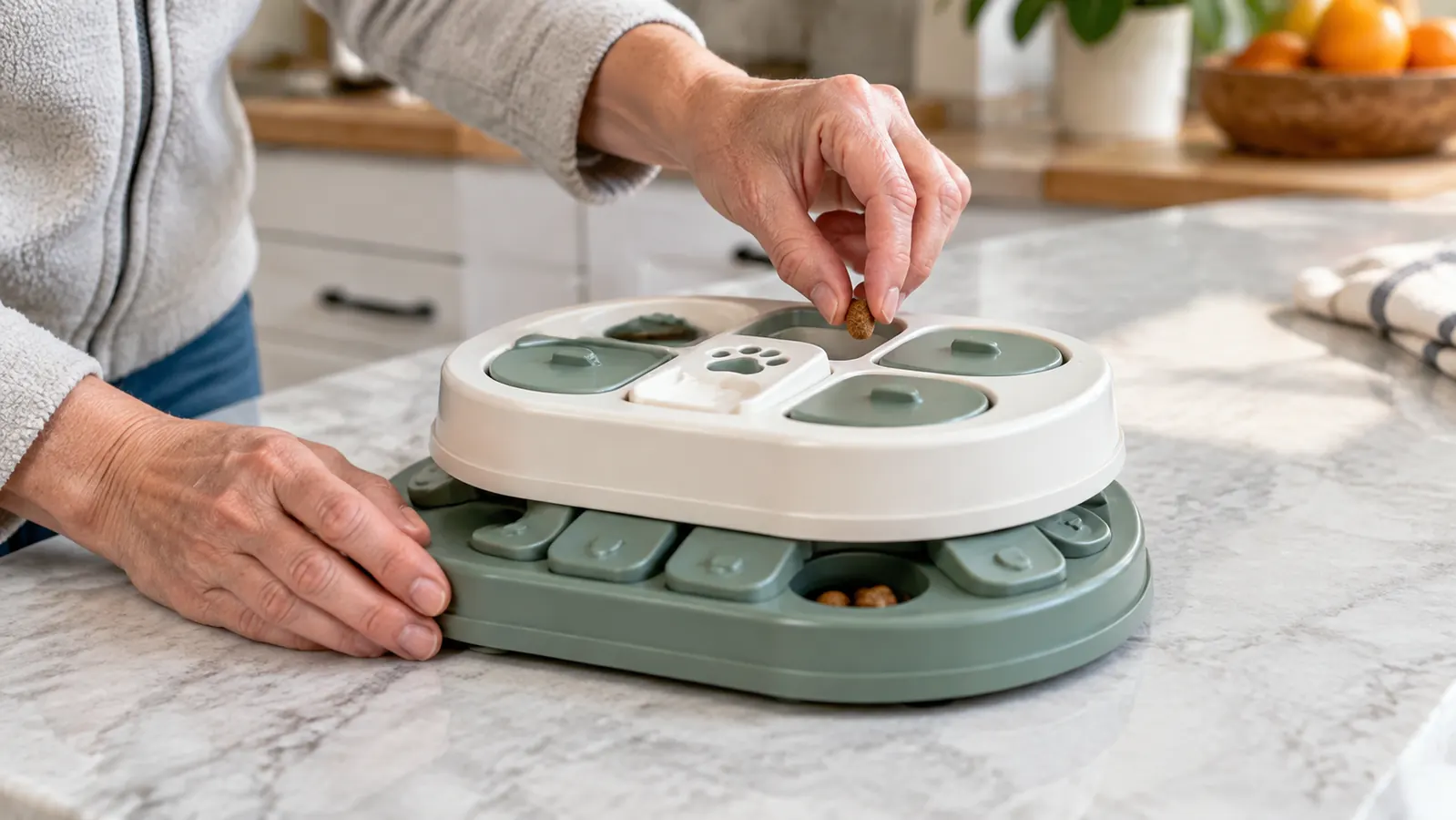
What the KADTC Puzzle Feeder Does Well
Let me start with the most important thing. The KADTC slows fast eating. For June, a meal that used to take two minutes now takes between six and eleven minutes, depending on how much she has to search. The second level adds enough complexity that she cannot simply sweep food out the way she can with a flat tray. She has to move pieces, check each opening, and circle back to spots she passed.
The second thing it does well is give a bored dog a job. Rainy days are the hardest days for a dog like June. She has a fenced yard and she gets a daily walk, but on bad-weather days she still needs something to think about. A puzzle feeder does not replace the walk, but it gives her twenty minutes of concentration before she settles on her bed. Those are twenty minutes I can use to make a phone call or unload the dishwasher.
The third thing is that it genuinely has two levels. That may sound like a small detail, but a flat slow bowl only offers one kind of work. The KADTC has an upper section and a lower section, and the lower section requires a little more problem solving. June is not a particularly clever dog, but she figured out that pushing pieces aside reveals food underneath. That extra step seems to be what keeps her from getting bored after the first week.
It is also easy to fill. I use June's regular kibble plus a tiny handful of training treats. I do not have to cut up special food or freeze anything. Some puzzle toys require prep work ahead of time, which means they end up in a cabinet after three uses. This one takes about thirty seconds to fill, and that is why it actually gets used.
What Nobody Tells You About Puzzle Feeders
Now for the part that sounds less like an advertisement. The KADTC is not a training tool the way a clicker or a leash is. It does not teach a dog to look at you, it does not build impulse control, and it does not fix separation anxiety. I have met owners who bought a puzzle feeder hoping it would calm a dog who panics when they leave. It will not. A puzzle feeder is a mealtime activity. It can lower the energy in a room for a short while, and that is real. But when the food is gone, the dog returns to whatever it felt before.
The second thing nobody tells you is that some dogs will walk away. If a dog is not interested in kibble, or if the dog gets frustrated because the food is hard to reach, they may leave the feeder and stare at you until you provide a normal bowl. I saw this with one client dog who would rather sniff the yard than work for dinner. That is not a flaw in the KADTC, but it is the difference between a tool that helps and one that sits in a closet.
The third thing is the piece-size problem. Every puzzle feeder has an ideal piece size, and this one is no different. If I use treats that are too big, they jam in the opening and June spends two minutes pawing at a spot with nothing inside. If I use treats that are too small, they fall out when she flips a section, and then she does not have to work at all. The fix is easy once you know it: use pieces about the size of a pea. But you may not know it until after a frustrating meal or two.
The surface under the feeder also matters more than you would think. On smooth tile, June can slide the whole feeder around and knock pieces onto the floor. On a rug or a rubber mat, it stays put and she has to work the way the toy intends. I ended up setting ours on a placemat. That is not a complaint about the KADTC, just a practical detail that makes the difference between a calm meal and kibble everywhere.
How It Has Held Up After Six Weeks
I have used the KADTC almost daily for six weeks, which is long enough to tell a well-made toy from a one-week novelty. June is not a destructive chewer, but she is not gentle with her paws. She flips pieces, presses down hard, and occasionally picks the whole feeder up and shakes it. The material has no cracks, the sections still fit together, and the base still sits flat. I cannot promise it will survive a power chewer, because very few toys do. For a normal large dog, it has held up very well.
The real weak spot is cleaning. Treat dust and kibble crumbs work their way into corners, and you need a small brush or a toothpick to get everything out. I wash mine by hand in warm water and let it air dry. I have not put it in the dishwasher because I do not know how the material will react to high heat. This adds about three minutes to my evening routine. If you dislike hand-washing dishes, you will notice it.
I also used it with the young heavy-pawed client dog I mentioned earlier. He slammed toys against the floor, and the KADTC survived that session without any broken parts. The weak points on any puzzle toy are the tabs and hinges, and on this one they have held up so far. I will keep using mine and I will update this section if that changes.

What I Would Change
If I could change one thing, it would be the grip on the bottom. The KADTC needs more traction than it has. I solved that by setting mine on a silicone placemat, but an owner should not have to buy an extra item to make a feeder work. A strip of grippy material on the base would fix this.
I also wish the cleaning instructions were clearer. The box does not say whether this feeder is dishwasher safe, so I was left guessing. A simple card that says hand wash in warm water would have saved me from having to search for an answer on a phone.
Finally, I would like more guidance for people who have never used a puzzle feeder. The instructions describe how to fill the toy, but they do not explain what to do when a dog gets frustrated or loses interest. That is exactly where most owners give up. A short troubleshooting section would make this a better first puzzle toy for a beginner.
What I Liked
- Slowed June from a two-minute meal to nine minutes on the first night
- Two levels keep a smart dog engaged longer than a flat slow bowl
- Easy to fill with regular kibble and small training treats
- Held up to six weeks of daily use from a 62-pound dog
- Gives an owner ten to fifteen quiet minutes at dinner
Where It Falls Short
- Not for a dog who walks away from food or gives up easily
- Cleaning by hand with a small brush takes extra effort
- Treat size has to match the openings or pieces jam and fall out
- Base needs a mat or placemat on smooth floors
- Will not fix anxiety, reactivity, or behavior that needs training
That first night, June took nine minutes to eat a meal she normally finishes in two. I counted.
Who This Is For
This puzzle feeder is for a food-motivated dog who eats too fast, a smart dog who needs something to do on a rainy afternoon, or an owner who wants a low-effort way to add mental work to dinner. That sounds simple, but it is actually a narrow group. A dog who is not interested in food will not engage with it. A dog who can already solve every puzzle in five minutes will be bored. For the dog in the middle, the one who loves treats and needs a little more to do, this is a good match.
June is exactly that dog, and I will keep using ours after this review is over. I like that it takes regular kibble, that it does not need batteries or an app, and that it does not try to be more than a mealtime toy. If you are looking for a tool to use alongside a little training, this one earns a place in the cabinet.
Who Should Skip It
Skip the KADTC if your dog is not food driven. It seems like every dog loves food, but some dogs would rather play or smell the yard than work for kibble. For those dogs, this will be a one-time novelty. I would also skip it for a puppy or an adult dog who chews and swallows pieces of toys. Even though the KADTC is not brittle, no puzzle toy is safe for a dog who treats it like a chew toy. Supervise the first few uses and put it away when it is empty.
Most importantly, skip it if you expect this to solve a behavior problem. If your dog barks at the window all day, chases the cat, or panics when you leave, the dog does not need a puzzle feeder, they need a training plan. I am a trainer, so I will always say that. Buy the KADTC because you want to slow down a fast eater or give a smart dog a job. Do not buy it because you are hoping for a fix for everything. The honest version is that it is a useful bowl, not a cure-all, and that is okay.
The Bottom Line
The KADTC puzzle feeder is not the kind of product that changes a dog overnight, and it is not supposed to be. It is a well-made mealtime tool for a specific kind of dog. If your dog eats too fast or acts restless on rainy days, this will give you a few quiet minutes and some welcome mental work. If you expect it to do the job of a trainer or a behavior plan, you will be disappointed. That is not the feeder's fault. It is a matter of using the right tool for the right job.
My final advice is simple. Try it with your dog's regular dinner, watch how they interact, and do not judge it on the first use. Some dogs need a few sessions before they understand the game. Others will never understand it, and that is okay. For the dogs who do take to it, the KADTC earns a permanent place in the dinner routine. I have seen it work, and I will keep using mine.
See Today's Price for the KADTC Puzzle Feeder
If your dog rushes through meals or seems bored in the evening, this two-level puzzle feeder might make dinner more interesting. It will not replace training, but it can give both of you a calmer routine. Check today's price on Amazon and see what recent owners say.
Amazon Check Today's Price on Amazon →