Which is the better answer for a bored dog: a food puzzle that makes the dog work for dinner, or a hollow chew toy you stuff with something tasty and hand over? The question comes up in almost every home I visit. By the time I arrive, the dog has usually stopped being merely bored. He is barking at the window, unrolling toilet paper, or following his owner around the house nudging for something to do. The owner has already walked him. She has already thrown the tennis ball. What she needs is a tool that works on an ordinary Tuesday when the weather is bad and she still has laundry to fold.
The short answer: if your dog's restlessness appears right after a meal that disappears in under five minutes, I point you to the KADTC 2-Level Dog Puzzle and Treat Dispenser. If your dog's restlessness shows up as chewing on anything that is not a chew toy, I hand you the Kong Classic. These are not the same solution wearing different packaging. The Kong asks a dog's mouth to stay busy. The KADTC asks a dog's brain to do the work, and it slows dinner at the same time. When owners ask me to compare them, I always start with one question: what does your dog actually do when he is bored?
Side by Side: KADTC vs. Kong Classic
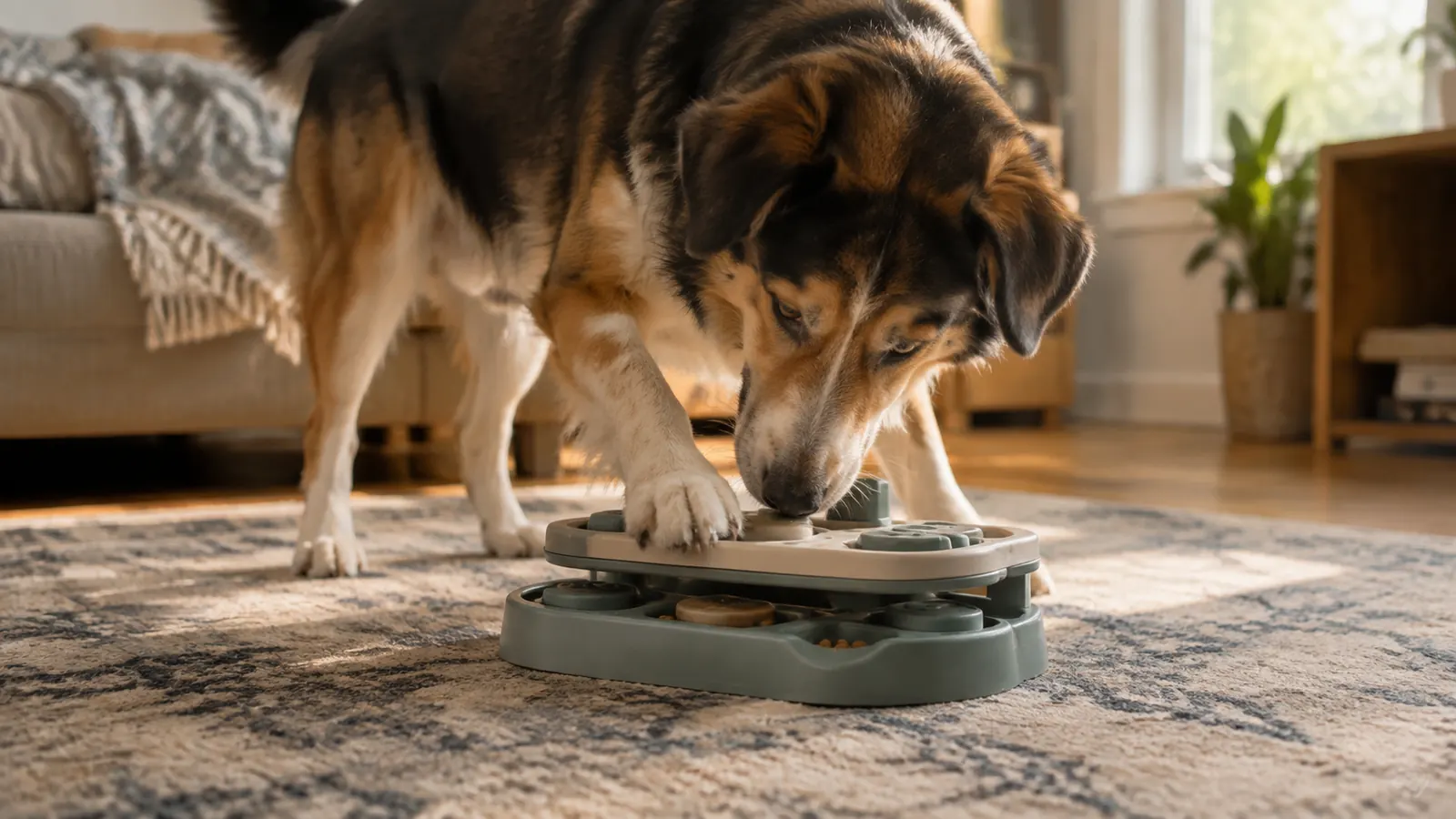
The KADTC puzzle feeder is a two-level plastic puzzle. You spread food across the lower level, put the upper level into place, and set the whole thing in front of the dog. Kibble stays tucked into pockets and gaps, so the dog can smell it but has to nose, paw and work the toy to get it out. Because it has two levels, you control the difficulty. First sessions can be loose and easy. Later sessions can be arranged with food tucked into harder spots, which gives the toy a longer useful life than a one-note plastic feeder. I use my own 62 pound shelter mix, June, as the test dog in this comparison, and I always load it with her normal dinner rather than treats.
The Kong Classic is one molded piece of rubber with a wide base and a hollow opening at the top. You stuff the hollow with moistened food, a few biscuits, or a smear of peanut butter, then let the dog chew and lick the contents out. A loosely stuffed Kong empties in a few minutes. A Kong filled with moistened food and frozen overnight gives a dog a much longer project. It has no levels, no instructions, and nothing to take apart. It has been doing its one job for a very long time, and there is a reason so many owners already own one.
| KADTC Puzzle Feeder | Kong Classic | |
|---|---|---|
| Price | Costs more because it has two levels and more parts | Costs less and is a staple that is easy to replace |
| Material | Molded plastic made for nosing and pawing, not chewing | One-piece rubber designed to take chewing |
| Chew resistance | A determined chewer can damage the edges or pockets | No seams or separate pieces for a dog to pry apart |
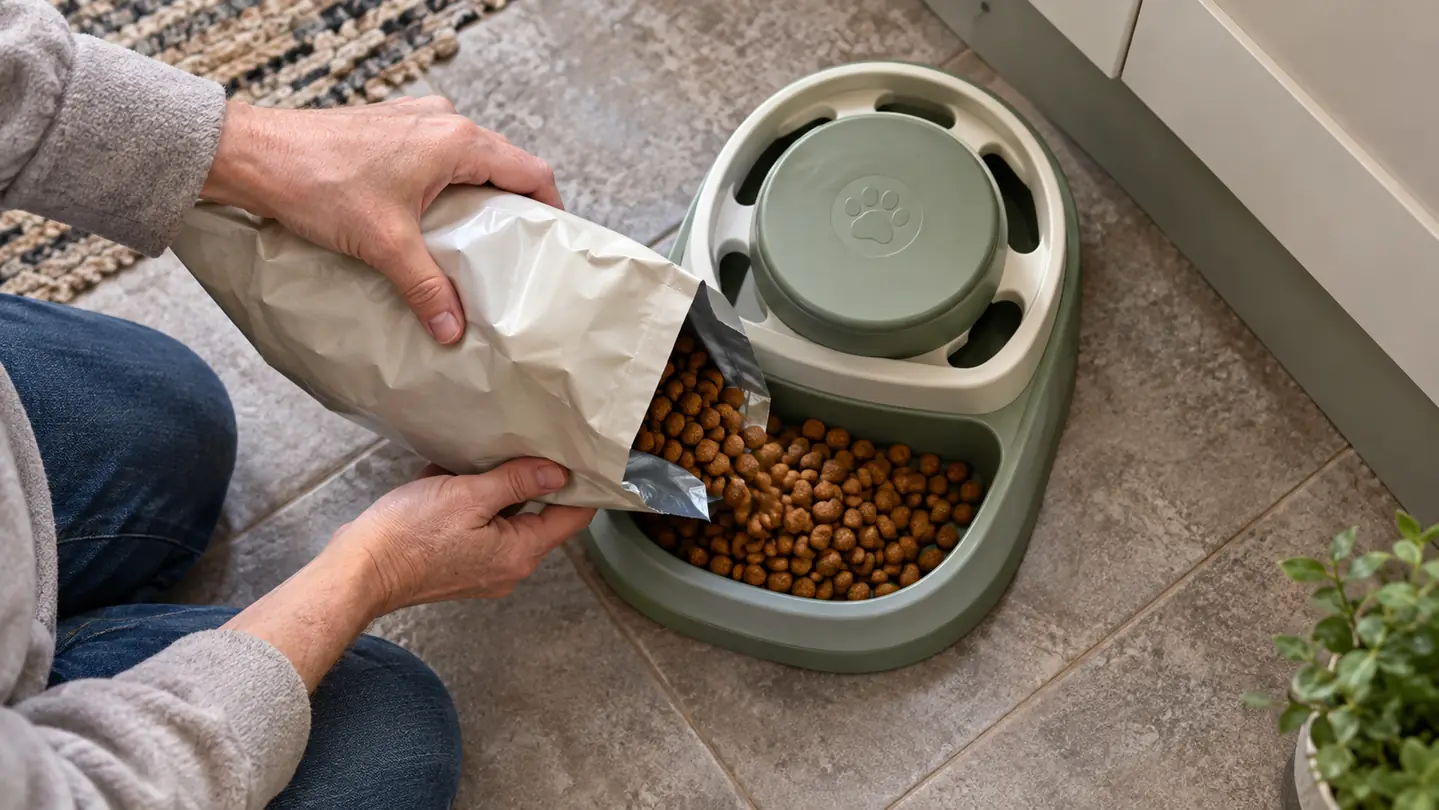
| Can it hold a full dinner | Yes, a normal portion of kibble fits across the two levels | The hollow holds a snack or a small portion, not a full meal |
| How the dog works | Sniffs, pushes, paws and searches multiple food spots | Holds the toy still and chews or licks at a single opening |
| Type of mental work | Problem-solving, decision-making and some paw coordination | Mostly soothing repetitive licking and chewing |
| Session length | Most dogs spend 10 to 20 minutes on a loaded dinner | Loose stuffing lasts minutes; freezing the contents makes it much longer |
| Cleaning | Hand-washable and the pieces rinse quickly in the sink | Top-rack dishwasher safe |
| Best boredom fit | A fast eater who needs an evening job | A strong chewer who unwinds with his mouth |
Where the KADTC Puzzle Feeder Wins
The KADTC wins on a problem that has almost nothing to do with how long a dog can chew. A bored dog is frequently a dog whose brain has been given nothing to do after the walk ends. In my own kitchen last February, on an evening when freezing rain kept June out of the yard, I put her dinner in the puzzle instead of the bowl. She nudged it, circled it, and came back to the same spot three times before she started using her nose. What struck me was not her speed but her effort. She was making choices, not gulping. By the third week I started timing her with the timer on my phone. A bowl took her about three minutes. The same cup of food took her eighteen minutes and twenty seconds when I arranged both levels and tucked a few pieces into the harder pockets.
Why does that settle a dog? Because every time she chooses a spot, discovers it is empty, and moves to another, her brain is doing the kind of work dogs were bred to do. Smelling, probing, deciding and trying again. That is the difference I point out to owners who tell me they already walk their dog twice a day. A walk uses the legs. A puzzle feeder uses the part of the dog that gets bored, and an eighteen minute meal left June yawning and stretched out on the rug in a way that a forty minute stroll in the rain never did.
June worked for eighteen minutes and twenty seconds on the same dinner she normally inhales in three, then lay down and stayed down.
The second advantage is the second level. It is the reason this feeder has not ended up in the back of a closet at my house. A flat puzzle with one set of hiding spots loses its challenge once a smart dog learns where everything goes. With the KADTC, I can start June on the lower level with the upper level removed, then add the second level back once she has the routine. I can also change where the food is tucked from one day to the next. That may sound like a small detail, but it is the difference between a toy a dog solves once and a feeder she still finds interesting three months later.
The feeder also earns its keep because it replaces a bowl instead of adding another snack. June gets two meals a day, and I can make either one a puzzle session without adding calories or buying special treats. For a dog who is slightly overweight, which describes a lot of the bored dogs I meet, that matters. The dog gets the mental work she needs and still eats exactly the portion she was going to eat anyway. That is a benefit no chew toy can offer, because a chew toy always has to be filled with something extra.
Where the Kong Classic Wins
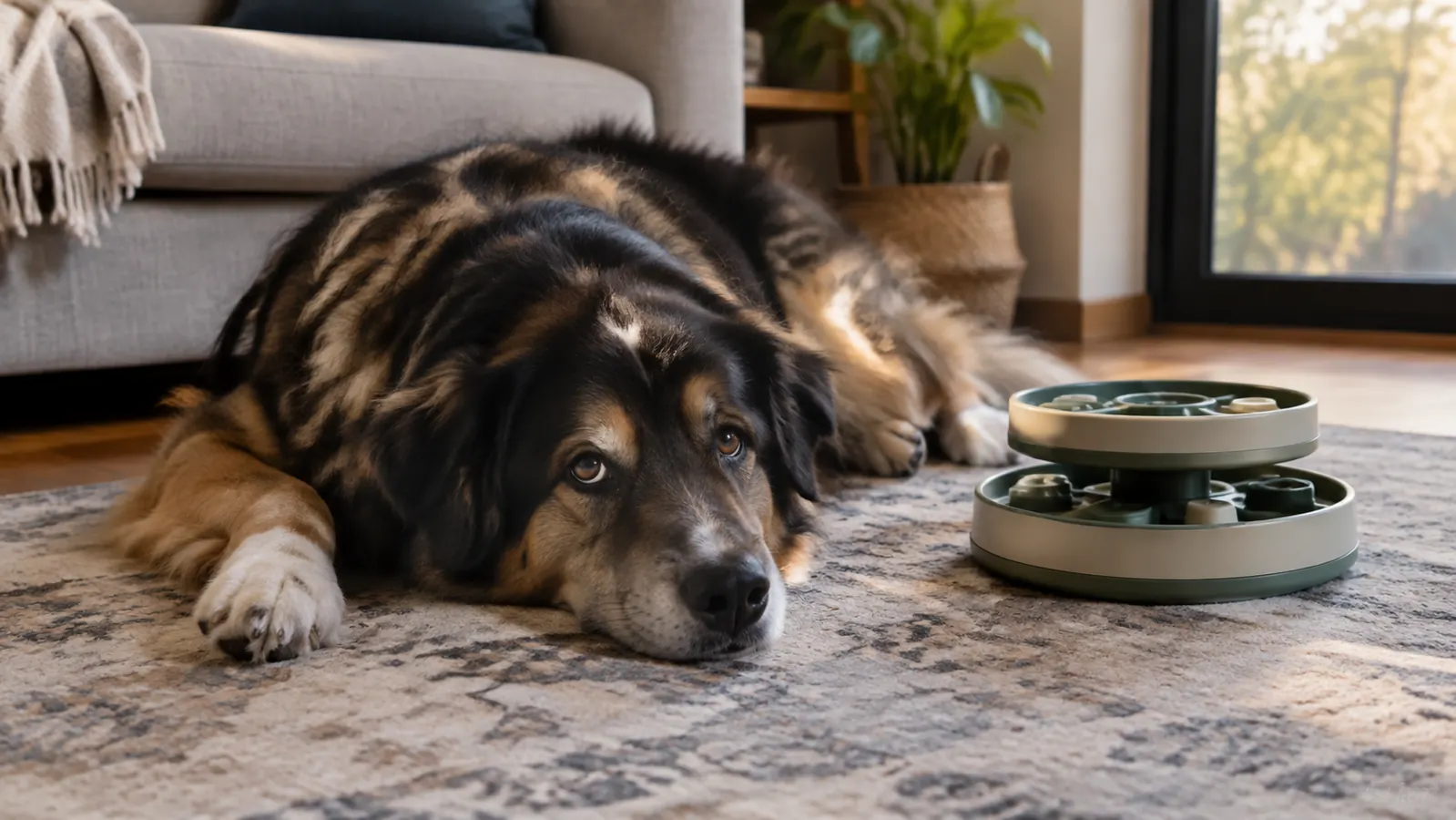
I will be honest with you about where the Kong wins, because it wins big in the right house. The KADTC puzzle feeder is plastic, and plastic has limits. A dog who chews to settle down is not a dog who should be given a puzzle with edges and pockets to gnaw. He will probably find it interesting for exactly one meal, then decide the real game is pulling the two levels apart with his teeth. That is not a flaw in a slow feeder. It is a mismatch of tools. The Kong Classic, with its single molded piece of rubber and no removable parts, gives a determined chewer a safer target and a much longer project.
The Kong also wins on convenience. There is nothing to assemble and nothing to keep track of. You open the bag, stuff the hollow, and hand it over. When the dog is done, the toy goes onto the top rack of the dishwasher. Compare that with a feeder that has multiple pieces to rinse by hand, and you can see why the Kong remains the toy I recommend to owners who want the least possible fuss. For a short session, a loose stuffing with a few biscuits is enough. For a longer stretch, moistened food and a night in the freezer turns the same Kong into a completely different activity.
There is one more thing I tell every owner who asks about bored dogs, and it applies to both toys. No chew toy and no puzzle feeder is a treatment for true separation anxiety. If a dog drools, paces, howls or injures himself when his owner leaves, a stuffed Kong will not fix that, and neither will a puzzle board. That dog needs a veterinarian who understands behavior and a real behavior plan. But for the far more common situation, a dog who is simply restless after dinner and needs a better outlet, both of these tools have a place. Which one fits depends on the dog.
If dinner ends in four minutes, this is the feeder I hand you first
The KADTC two-level puzzle turns the meal your dog already eats into a session of real thinking. It is not the right tool for a hard-core chewer, but it is the one I keep recommending for a fast eater who paces for the rest of the evening.
Amazon Check Today's Price on Amazon →Who Should Buy Which
Buy the KADTC puzzle feeder if your dog's boredom shows up after meals. You know the dog I mean. He inhales dinner in four minutes, stares at the empty bowl, and then spends the next two hours parked at the window or pacing between your chair and the back door. This feeder also suits a dog who is food motivated, a dog who already knows how to use his nose, and a dog who does not have a serious chewing history. It is the better first purchase for the average restless family pet because it gives him a thinking job every single day at no extra calorie cost.
Buy the Kong Classic if your dog is primarily a chewer. You know this dog too. He is the one who destroyed every plush toy by Tuesday, the one who would rather hold something in his jaws than do anything else with his evening. The Kong gives that dog a safe, durable outlet. It is also the better choice if you want a toy you can hand over while you take a shower or make a phone call, and it is the better choice if you hate hand washing dog dishes and want something you can put in the dishwasher.
Some households honestly have room for both, because the two toys solve different problems. The puzzle feeder gives a fast eater a brain workout at mealtime. The Kong gives a mouthy dog a soothing chew session later in the evening. I do not tell every client to rush out and buy both at once. I tell them to buy the one that matches the dog they live with today, and to keep the other in mind if they ever discover the first tool is not solving the right problem.
So which one wins on boredom? The honest answer is that the winner is the tool that fits the dog. If your dog is restless because his brain has nothing to do after dinner, the KADTC puzzle feeder wins on most ordinary evenings. If your dog is restless because his jaws need a legitimate job, the Kong Classic wins and it is not close. The mistake is buying the wrong one and then deciding that neither works. Match the tool to the behavior, and you will probably find that your dog was not bored at all. He just needed the right kind of work.
Still choosing? Watch what your dog does after dinner
If he finishes his meal and immediately looks for trouble, the KADTC two-level feeder is the tool I would try first. It turns his regular dinner into a thinking session and gives the restless evening a clear ending.
Amazon Check Today's Price on Amazon →